




 In a report to Cincinnati City Council, City Manager Milton Dohoney Jr. provides rough guidelines on how the City should put its scenic view study to use.
The report is a follow-up to a June 2007 motion by City Council asking City administration to convene a task force to identify implementation strategies for the Cincinnati Scenic View Study.
The task force was composed of members from the City's Law, Community Development and Planning, Buildings and Inspections and Parks and Recreation departments; The Hillside Trust; a developer; and community representatives from three neighborhoods with had views identified in the study.
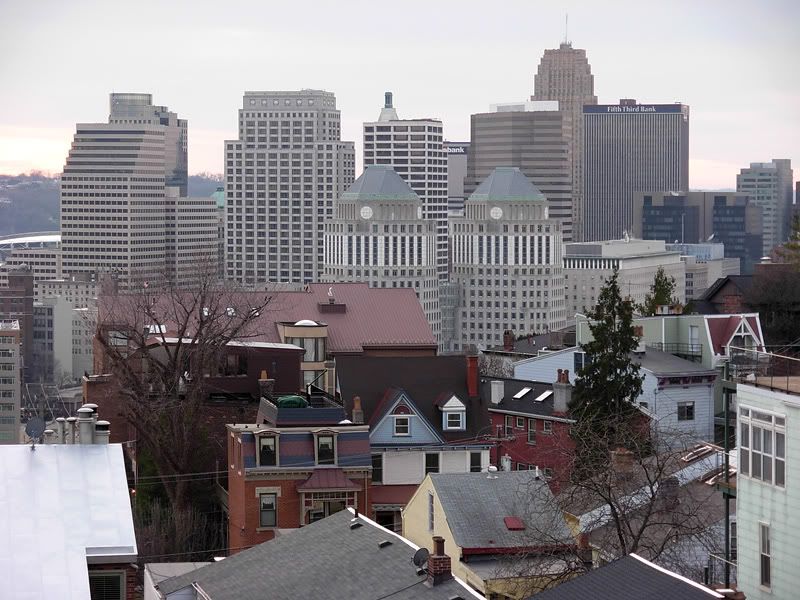
"The view of the 'green' wall from the Downtown basin area distinguish Cincinnati from its suburban neighbors and other Midwestern cities," Dohoney says. "The benefits of these public views are many, including contributing to the area's beauty and cultural identity, creating a sense of place for residents, providing a source of civic pride and enjoyment, providing opportunities for tourism, and enhancing property values for adjacent residents and businesses with a corresponding increase in property tax revenues."
The $75,000 study, prepared by the City's Department of Transportation and Engineering, Human Nature, Inc., and The Hillside Trust, began with a site inventory of scenic views from 93 publicly-owned properties.
Each view was documented photographically and topographically and entered into the City's CAGIS system.
Locations were also ranked according to view quality, land use type, and availability of the view year-round, with over half of the views ranked "high priority".
Dohoney believes that these view corridors should be preserved for future generations.
"Cincinnati’s hillsides and the Ohio River are broadly recognized as the area’s defining natural features," he says. "The views of the river, the hillsides, and the cityscape of downtown from public areas atop these hillsides are a priceless legacy for all Cincinnatians and can be source of great pride for our community"
Awareness
To raise awareness and appreciation of the City's scenic views, the study recommended a self-guided tour, similar to the Queen City Tour.
Dohoney says that with the maintenance help of DOTE, Public Services, the Cincinnati Park Board and the Cincinnati Recreation Commission, costs to implement such a tour would be minimal.
"The initial viewpoint mapping was completed with the original study, and only a modest effort will be required to determine mapping, routing, and driving directions," he says. "Wayfinding, location signage, and printed map materials form the primary costs. Once the initial tour is established, maps could be provided online from the City's website for visitors to print for themselves; this online arrangement would also allow mapping to be updated without additional printing costs."
Dohoney estimates that the design and construction work would cost approximately $20,000 and he says that it should be considered in the upcoming capital budget process.
He also believes that private partners could be brought in to contribute financially to the project.
Conservation
Of the high priority view corridors, eight are not completely public and twelve are susceptible to being lost by high-rise residential development.
"The only fair and true method to ensure view protection is ownership of the property by the City, or by a conservancy dedicated to the preservation of these public views," Dohoney says.
However, City policy doesn't allow it to hold on to excess property, a practice that Dohoney says would need to change.
"Currently City of Cincinnati policy calls for the City to divest itself of surplus property in order to return property to 'useful development' and to the tax rolls," he says.
Dohoney says that public-private partnerships involving the acquisition or receipt of gifts of view properties or view easements could be a useful strategy.
"Acquisitions should be targeted in areas where landslide susceptibility is high, where leaving the area as green space is supportive of storm water detention policies and needs, and where the area can be aggregated with other public lands or easements to extend the City's greenway and parkway system as identified in the Park Board's Centennial Master Plan," he says.
Of course, money is always an issue.
"Any acquisition program must exist within the parameters of the City's budgeting process and financial capacity," Dohoney says.
One solution to alleviate any financial liabilities to the City could be the creation of a View Shed Conservancy, which would be responsible for management of the view corridors and obtaining funding from organizations and foundations that might not be available if the land were City-owned.
Several agencies currently hold land for public purposes, including the Hillside Trust, Little Miami, Inc., and the Park Board.
"By all accounts, these organizations, public and private, adequately manage their seperate holdings and can serve the same purposes as a View Shed Conservancy, albeit in a fashion independent of one another," Dohoney says. "Issues for these organizations, like that of a single View Shed Conservancy, are funding, management, and scope, because the costs of acquiring property or easements and the costs of maintenance and management of their properties would have to be met with a consistent, reliable source of funding."
Dohoney recommends revisiting the idea of a conservancy in two to three years.
In the interim, he believes that the City should create a program or process to actively solicit gifts or grants of scenic view properties or easements and should look for ways to fund their maintenance.
Zoning
Because the source of the views - though not the entire corridors - are publicly owned, zoning can be used as a tool to regulate how adjacent privately-owned land is developed.
"Any potential new zoning and subdivision regulations should be carefully crafted and considered to recognize their possible economic implications, impacts on private property rights, and susceptibility to legal challenge," Dohoney says.
Dohoney suggests two view protection options - hillside development ordinances, and ridgeline development guidelines.
"Again, applying highly restrictive regulations or prohibitions requires serious consideration of the potential options for relief for existing property owners that may be affected," he says. "Such relief may not be as necessary or onerous if ordinance permit development through appropriate guidance and development standards, rather than prohibiting development altogether."
This would be accomplished through the use of View Protection Overlay districts, written into the City's zoning code and based upon the City's Environmental Quality - Hillside District guidelines, the Hillside Trust's Development Guidelines for Greater Cincinnati, and current best practices.
All projects proposed for these districts would be subject to review by the City's hearing examiner.
"This review may require additional staff time, and review and permitting time, but this additional effort and expense may be necessary to protect these valuable assets," Dohoney says.
Copies of the Cincinnati Scenic View Study have been sent to the Department of City Planning's recently established Zoning Code Committee for consideration.
Columbia Parkway
Because of Columbia Parkway's winding path and changes in topography, its ever-changing views present a multitude of problems.
To accurately map this important corridor, Dohoney suggests an interactive digital model that can be used to develop standards, guidelines, and controls.
"The Kent [Connecticut] project built a digital landscape that modeled view corridors from various rights-of-way to determine where view planes would be crossed by the height or width of new development," he says. "The same modeling procedures can be established for Columbia Parkway so that we could provide accurate information about appropriate maximum building heights and envelopes along the south slope of the Parkway, and for riverbank lands along Eastern Avenue and Riverside Drive."
Dohoney thinks that this model can also be used to create more consistent zoning regulations along Eastern Avenue and Riverside Drive, currently a patchwork of allowable heights and uses.
Because the model would require significant technical experience, the cost is estimated at between $20,000 and $30,000.
The Hillside Trust is currently pursuing grant funding for the project.
Until the model can be developed, Dohoney says that any new development between Columbia Parkway and the Ohio River should be limited to the height of Columbia Parkway at its nearest point to the proposed building.
Thursday, June 26, 2008
Dohoney reports on next steps of scenic view study